I was late to the health food store on Friday and didn't have much to choose from on the fresh veggies shelf. In fact, there was only a small package of near-organic tiny green bitter melons at the ridiculous price of about one USD. I looked online for recipes and found none that fit the ingredients available in the refrigerator. I did note the prominence of tomatoes and curries made with bitter melon and incorporated a dash of curry (my family is not as fond of spicy foods as I am) and the last sagging (perfect for sauteing) tomato. My gamble based on gut intuition (according to the recent science news that we have brains in our stomachs, and as the way to a family's heart is through the stomach) was to make cloves the featured sweet but punchy spice to pull off a delicious dish. To my own amazement, it worked!
Side dish size (serves 3-4 people).
How to Make It
Wash and halve the bitter melons. Core them with a coffee spoon. Slice it to 1/4-cm or 16th-inch wedges around the cored melons.
Peel, wash, and cut the red onion into just slightly larger wedges (which look like slivers from a distance).
Wash and dice the tomato into one-centimeter or half-inch cubes (more or less).
Heat up the flat frying pan or whatever shape of metal you prefer to medium hot (so the gas flame is tickling the pan but firing up its molecules so that it will burn the saute, which is not a barbecue).
Add grape seed oil (enough to protect the veggies you are about to toss in) and olive oil (because it tastes great and add variety to the lubrication).
The bitter melon is usually hard as Masonite, so toss it in first, followed immediately by all the spices (see below), then always (more or less, pause to let it brown a tad) keep scraping and stirring with a flat (and flat-edged) steel spatula. (This of course prevents organic materials from accumulating and burning.) After they look slightly in need of company, toss in the red onions, noting the beauty of the color combination and how long it must wait for the tomato--a very long time (at least ten minutes).
It is at this stage that you may fear the saute in danger of becoming too dry and burning, yet the melon has yet to be fully cooked (I detest having to boil them ahead of time). Thus, here you need some form of liquid enhancement. Of course water is an option--no it is not; it would rob your dish of any hope of achieving panache and leave you miserable for the whole evening. Here you need cooking wine of some sort. I grabbed what I saw handy: bootleg clear liquor that the melons seemed to love. (Those of you struggling in 12-step programs, fear not, for the alcohol burns away leaving only a residue of the secret ingredient of all cooking: LOVE).
Toss in the tomato. Stir for another 2-3 minutes.
Add the brown sugar, stir in, and again after a minute, and it is done.
Find a bowl for serving it (don't just leave it in the pan simmering into hellish sogginess).
Main ingredients:
Bitter green melons (4-6 tiny ones that fit palm of your closed hand)
Red onion (one small one will be enough)
Tomato (one medium-large one or two small ones, or perhaps a dozen halved cherry tomatoes)
Spices:
Fresh whole cloves (ten; fresh means that when you open the bag or container the smell knocks you over)
Curry powder (a teaspoon or to taste, depending on the curry powder you prefer; I usually use the one sold in most Vietnamese restaurants)
Fresh ground green cardamon (one teaspoon, peel them and grind the seeds in the pod, or pulverize them in a pestle/mortar)
Salt (one teaspoon; I can't recommend sea salt anymore since it is found to have plastic crystallized in it--even in Antarctica!)
Other:
Bootleg plain cooking liquor (optional; ask your Taiwanese friends)
Brown sugar (one and a half tablespoons or to taste; try to use organic or least processed)
Grape seed oil
Olive oil
Saturday, 16 June 2018


Friday, 8 June 2018

Thursday, 31 May 2018
Postcolonial positioning and Japanese imperial affect in interwar Dada prose poems
This article supplements my book Japanese Poetry and Its Publics (politics), which mostly treats tanka, and some senryu. This piece focuses on Kitagawa Fuyuhiko's experimental prose poems.
The book and this piece are all thanks to the encouragement of Phillip Darby, editor of the Postcolonial Politics book series and the journal Postcolonial Studies.
eprints (50 available) are here:
https://www.tandfonline.com/

The book and this piece are all thanks to the encouragement of Phillip Darby, editor of the Postcolonial Politics book series and the journal Postcolonial Studies.
eprints (50 available) are here:
https://www.tandfonline.com/
email: interpoetics@gmail.com
Saturday, 21 April 2018
Old-Fashioned Raisin Bars with Ingredients Available in Taiwan (Best Ever)
This afternoon my eldest daughter (kindergarten age) and I baked these bar cookies (standard 10X15 inch teflon baking pan--hard to tell from photo).
We followed the recipe, choosing to use olive oil, Taiwanese brown sugar, and mixed the spices using a ceramic mortar and pestle: half a dozen fresh cloves, fresh nutmeg shaved off with a paring knife (less than a teaspoon, as it was pungent and I was afraid it would be too much), and fresh powdered cinnamon. The pan was greased with butter, and we didn't have powdered sugar, so the photo lacks flair, but I highly recommend it. Thanks to my trusty Better Homes and Garden Betty Crocker knockoff dragged around for decades.


Sunday, 11 March 2018
German Sweet Potatoes Perfect with Basic Ingredients Available in Taiwan

I'm back to cooking (just got an oven) and really enjoying it. The first run included vegetarian mushrooms and fungi pasta, pork pasta, bibimbob (비빔밥), Japanese udon and then hot-pot (miso flavor), with side dishes including cucumber and tomato salad (thanks to my Aunt Barbara's recipe), and these sweet potatoes. They took about 40 minutes to boil. Rinse in cold water (they retain enough heat for the butter to melt still). Slice into 1/2-inch or so slabs or slightly thicker tops and bottoms of the taters.
Oh, I skipped the bread crumbs, and thought they were great still. As my wife is watching her cholesterol, I didn't use more than a tablespoon or so for the whole batch of 6 smallish sweet potatoes (地瓜), and spread a thin layer of olive oil over the glass. The brown sugar was local and organic. The salt was coarse sea salt (turned out a bit too salty on some). Freshly ground pepper. Overall, it is a great variation on a local staple--and transports one to Europe (so I am told).
Now I just have to find cloves and nutmeg, so I can try more dishes in this book (once my mom's):

Source of recipe.
Monday, 27 November 2017
生態論述中的巴迪烏「改變」模式:福島核災川柳中的行動者與關係性
Immeasurable thanks to Huei-chu Chu 朱惠足 and Hannes Bergthaller for including my work on Badiou and intertextuality in Chinese, translated by Huei-chu Chu:
第四章 生態論述中的巴迪烏「改變」模式:福島核災川柳中的行動者與關係性/包德樂

第四章 生態論述中的巴迪烏「改變」模式:福島核災川柳中的行動者與關係性/包德樂
(Badiouian Models of Change in Ecological Discourse: Actants and Relationality in Senryū on the Fukushima Nuclear Disaster)
In:
全球生態論述與另類想像
作者:朱惠足、Bergthaller, Hannes、Phillips, Dana
主編定價:320
ISBN:9789574456796
主編定價:320
ISBN:9789574456796

Story in print: "The San Francisco Fun House" in the Incarceration anthology

Incarceration
Includes my speculative utopian satire
"The San Francisco Fun House"
Available here:
https://www.amazon.com/Incarceration-Various-Authors-ebook/dp/B072BTW4W1/ref=sr_1_1?ie=UTF8&qid=1511745636&sr=8-1&keywords=incarceration+carol
Book now out: Japanese Poetry and Its Publics: From Colonial Taiwan to Fukushima


Anyone interested in reviewing the book can obtain a copy through this form on the Routledge website: http://pages.email.
Also available here:
https://www.bookdepository.com/Japanese-Poetry-and-its-Publics-Dean-Anthony-Brink/9781138304024
Tuesday, 27 June 2017
"Affective Frames and Intra-relational Finites in Jorie Graham’s Sea Change" now online
Abstract
This article brings into conversation a Badiouian ethics and Karen Barad’s post-phenomenological relationality of “intra-actions” among the human and nonhuman so as to situate the environmentally and politically engaged poetry included in Jorie Graham’s Sea Change. Criticism has avoided exploring the interplay between stylistic choices and political dimensions in her poetry, which includes engagements with pressing environmental issues today (global warming, rising seas, and chaotic weather), preemptive wars, and questions of plausible poetic agency itself. Foregrounding a material dimension while still maintaining a sense of responsibility, this essay highlights Alain Badiou’s use of poetic configurations as “subjects” engaging in ethical world-recognitions that help situate an important underlying posthuman ethos evident in Graham’s poetry. Barad, in a discourse with roots in quantum physics, argues that we must rethink representation from an entirely different phenomenology of intra-actions, beginning with relations, not objects or Cartesian selves. Thus both Badiou and Barad, in radically different but complementary ways, situate ontological finites—poems and sites of intra-action—as means of overcoming Derridean différance, which remains one formal cornerstone of postmodern displacement evident in American mass media’s post-truth equalization of all positions without situating possibilities of coherent analysis or engagement. In conversation with the work of Judith Butler as well as Badiou and Barad, this essay intends to make a small contribution to feminist posthumanism and politics, and expand our sense of ethical and affective engagement in New Materialist criticism.
Appears in Neohelicon (2017). DOI :10.1007/s11059-017-0400-2
Appears in Neohelicon (2017). DOI :10.1007/s11059-017-0400-2
Access article (free) here: http://rdcu.be/tILd
Thursday, 8 June 2017
Score for Martyrdom of St. Lawrence (keyboard composition in progress)
Score for Martyrdom of St. Lawrence (keyboard composition in progress). The rest is in a notebook waiting for summer vacation.


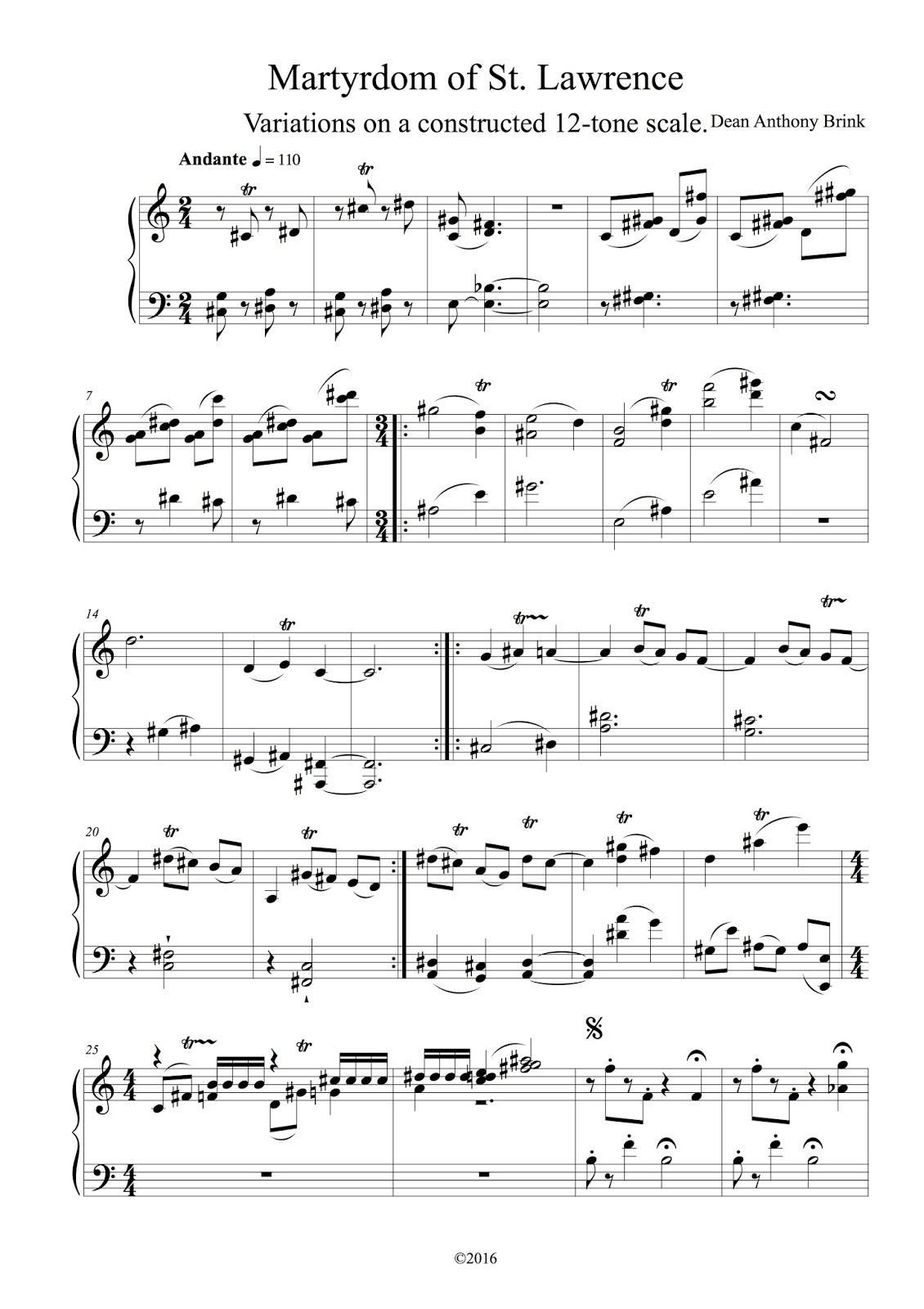

Audio renditions on Soundcloud here.
Monday, 5 June 2017
Aesthetic Configurations and Qualia in Environmental Consciousness in Contemporary Taiwanese Poetry and Installation Art (chapter online)

Huang
Zan Lun (黃贊倫), Anne.
FRP, Machine, Artificial Fur, Antlers, Turtle Shell, 90 x 150 x 90cm, 2013.
Tuesday, 11 April 2017
Trilingual Experimental Tanka (日本語 - English - 漢文)
なぜならば
ありえなくても
言いたいの
なぜ
そう聴けも
そう]先の
旗[
ありえなくても
言いたいの
なぜ
そう聴けも
そう]先の
旗[
because, I mean, so
we as is why enough as
is so is why is
so as is so as
is] the first
flag[
we as is why enough as
is so is why is
so as is so as
is] the first
flag[
因此我意為
這是如夠就我們
想說為什麼
就聽道到聽不到
就是這樣]第一
旗[
這是如夠就我們
想說為什麼
就聽道到聽不到
就是這樣]第一
旗[
Friday, 7 April 2017
One More Thing [
One More Thing [
sends half-billion in Tomahawks
cuts meals on after
school wheels
we now at war] false flag [winners
the time to get your gun get stationed
get it great again
don't dare you
skedaddle blindsided turn-
a-round now can don] hero [you
are as is why as as is does
people like it,
um, gosh, well
because, I mean, so we
as is why enough
as is so is why is
so as is so as is] the
first
flag [
wake up] stood! [paid the price] the dead [
bottoming out same ole']
move [the probe] "who" [
fallen in the last]
resort the oval [
the firing]
wired [
tap-]
ed [
.]
Saturday, 11 February 2017
Sound Work: "Social Justice for All for Some" in Technoculture (with artist's statement and link)
About This Work
The idea for this piece came when attempting to explore the effects of repetition of phrases that are in danger of becoming meaningless clichés, in this case making a statement in the driest of voices: computer-generated ones in English, French, and German. I originally planned to use a text-to-speech program, but after testing the Google Translation voices I decided to try them. The limitation I found was that the voices for non-European languages are not kept as current and polished as the European ones, which sounded very neutral (so proper almost uptight) and full of expected intonation that naturalizes the repeated phrases. This plays against the defamiliarizing effects of the synthesizer and collaged recordings.
The collage in effect attempts to present the fact of inequality under capitalism and its production of poverty to enrich the few while destroying the material security of lives as lived under neoliberalism, where "the market" is deemed to have authoritative (but elusive) agency. As people accept this subjection to capital a regular disavowal of human (and nonhuman) life occurs, breaking the social contract and care for our communities. The dissonant synthesizer intends to express this sentiment. In the process of editing, a connection to ecological concerns arose (due to extreme air pollution blowing across the Taiwan Strait), leading me to include summer mountain cicadas.
This experimental track features various multi-layered digitally synthesized analog synthesizer melodies (using a Korg Volca Beat run through a "KingKorg" synthesizer), sounds of subway doors closing as recorded in Osaka, mountain cicada recorded in nearby Yangmingshan National Park, as well as synthetic voices in several languages. This work combines my love of keyboards and conceptual art with my ongoing work in poetry and spoken word recording. Comments and questions are very welcome: interpoetics at gmail dot com.
Sound Work: "Social Justice for All for Some"
social-justice.mp3
Friday, 10 February 2017
Poetry Blogs and the Posthuman in Postcolonial Taiwan
Tamkang Review 46.2 (June 2016): 135-159.
DOI: 10.6184/TKR201606-7
Keywords: Postcolonialism, Taiwan, posthumanism, poetry by Taiwanese, social media, Taiwanese politics
https://www.academia.edu/31339034/Poetry_Blogs_and_the_Posthuman_in_Postcolonial_Taiwan
後殖民台灣的部落格詩歌與後人類
摘 要
本文根據 Alain Badiou, Jodi Dean, Cary Wolfe, Katherine Hayles 等批評家之 理論來探討部落格詩的運用。上述理論家闡明後人類自我生成之理論可形成讓 後殖民主體得以克服被外在規則壓迫的後遺症,並透過跨國家網絡,恢復某種 程度的主體性。吳昭新及李魁賢這些台灣詩人均發表針對當代台灣政治與美學 議題之中文、閩南語、日文與英文譯文之詩歌。對於影響至八零年代末期那些 外來政權所遺留下的壓迫傳統,這些部落格均持續挑戰與反抗。本文探討詩的 形式與部落格媒介何能在後人類的修復網絡中形成戰略,好擴大詩的運用而置 換國家機器,並同時能當作是去殖民與重新協商國際聯盟的工具。
關鍵字:後殖民、台灣、後人類學、台灣詩人作品、社群媒體、部落格、台灣 政治
摘 要
本文根據 Alain Badiou, Jodi Dean, Cary Wolfe, Katherine Hayles 等批評家之 理論來探討部落格詩的運用。上述理論家闡明後人類自我生成之理論可形成讓 後殖民主體得以克服被外在規則壓迫的後遺症,並透過跨國家網絡,恢復某種 程度的主體性。吳昭新及李魁賢這些台灣詩人均發表針對當代台灣政治與美學 議題之中文、閩南語、日文與英文譯文之詩歌。對於影響至八零年代末期那些 外來政權所遺留下的壓迫傳統,這些部落格均持續挑戰與反抗。本文探討詩的 形式與部落格媒介何能在後人類的修復網絡中形成戰略,好擴大詩的運用而置 換國家機器,並同時能當作是去殖民與重新協商國際聯盟的工具。
關鍵字:後殖民、台灣、後人類學、台灣詩人作品、社群媒體、部落格、台灣 政治
Subscribe to:
Posts (Atom)